Tybalt Quotes and Analysis – Romeo and Juliet (AQA GCSE)
By Julie at GCSE Ninja (a parent, not a teacher or examiner) · Updated 2 November 2026 · 6-minute read
Tybalt is Juliet’s hot-tempered cousin, a Capulet who lives for the feud. These Tybalt quotes show how hatred spreads from a street brawl to a death that costs the play its peace.
The quick version
- Who he is: Juliet’s cousin, who hates every Montague and stabs Mercutio.
- Learn three quotes: “I hate the word”, “not a sin” and “thou art a villain” (below).
- The exam move: do not write “Tybalt is angry”. Use him as proof of what the feud does to people.
Quotes · How hatred grows · Exam answer · Marks · Test yourself
3 Tybalt quotes to learn
Learn these three first. If you have time, open the box underneath for more.
“What, drawn and talk of peace? I hate the word / As I hate hell, all Montagues, and thee.”
Act 1 Scene 1
Say this: He treats peace as weakness. The simile “as I hate hell” makes his feeling extreme, and the list “all Montagues, and thee” widens his hatred from one man to a whole family.
“Now, by the stock and honor of my kin / To strike him dead I hold it not a sin.”
Act 1 Scene 5
Say this: He swears an oath on his family’s honour, and decides killing is “not a sin”. Pride and violence are joined. The setting is the Capulets’ own party, which makes it more shocking.
“Romeo, the love I bear thee can afford / No better term than this: thou art a villain.”
Act 3 Scene 1
Say this: The word “love” is turned into an insult. It is also ironic: Romeo has just married Tybalt’s cousin, though Tybalt does not know.
Tip: the irony in the third quote is worth a sentence. It shows Tybalt acting in the dark, which makes the tragedy worse.
More Tybalt quotes (open if you have time)
“Turn thee, Benvolio; look upon thy death.” (Act 1 Scene 1) Commands (imperatives). He gives orders to someone who wants peace.
“Patience perforce with willful choler meeting / Makes my flesh tremble in their different greeting.” (Act 1 Scene 5) Patience and anger fight inside his body. He cannot hold his temper back.
“Boy, this shall not excuse the injuries / That thou hast done me. Therefore turn and draw.” (Act 3 Scene 1) “Boy” is an insult to Romeo’s manhood, and “turn and draw” is a call to fight. The stage direction soon after is “Romeo attempts to beat down their rapiers. / Tybalt stabs Mercutio.”
Checked against the Folger Shakespeare Library text. Editions differ slightly, so check your own copy. “/” marks a line break.
How hatred grows
A strong answer follows the hatred. Do not list quotes. Show how it builds:
Four moments that show how Tybalt’s hatred ends.
To read these scenes, use the free Folger Shakespeare Library text: Act 1 Scene 1, Act 1 Scene 5 and Act 3 Scene 1.
How to use Tybalt in the exam
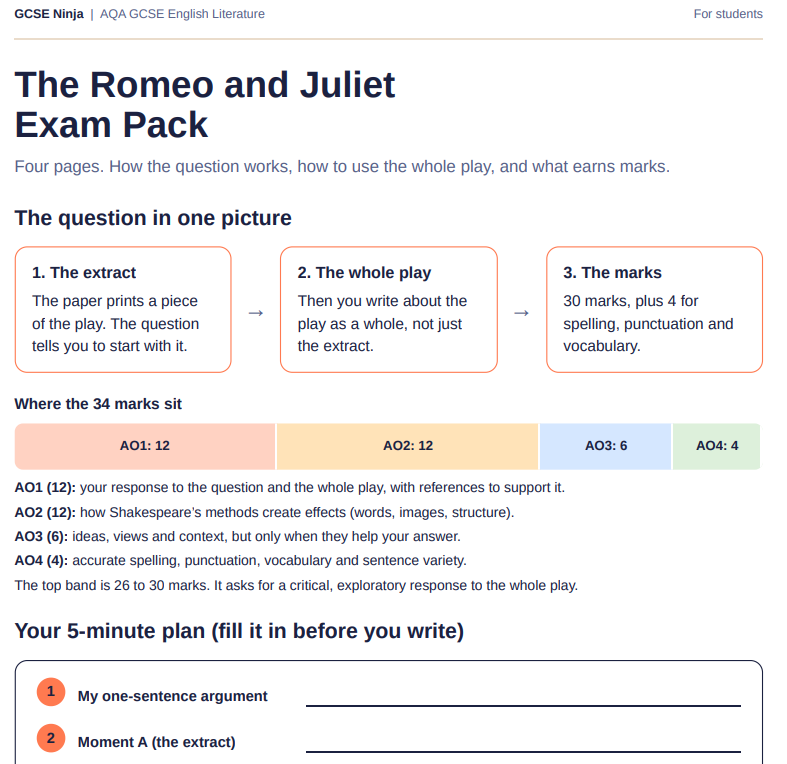
AQA gives you an extract, then asks you to write about it and the whole play. Tybalt matters most in Act 3 Scene 1, the scene where the play turns. None of the four papers we checked named him, so use him as evidence for a bigger idea, such as the feud or conflict. Here is our own practice question in that style (not an AQA question). When you have tried it, test yourself on real AQA English Literature past papers:
Your 5-minute plan
- Write one sentence that answers the question.
- Pick three moments: early, middle, late.
- For each, choose one quote and one method.
- Find the idea that links them (hatred, honour, consequences).
- Write your opening sentence before you start.
A model paragraph (our own example)
Shakespeare presents Tybalt as hatred made human, and shows that hatred harms the people who carry it. In Act 1 Scene 1 he rejects peace with a simile, “I hate the word / As I hate hell, all Montagues, and thee”, where the comparison with hell makes his feeling extreme and the list widens his target from one man to a whole family. By Act 1 Scene 5 he swears “by the stock and honor of my kin”, so his hatred is tied to pride in his family name, and he claims that killing is “not a sin”. When he meets Romeo in Act 3 Scene 1 he opens with an insult, “thou art a villain”, and the word “love” before it is turned into a weapon. Soon after, the stage direction “Tybalt falls” shows the violence he began coming back to him. This presents hatred as something that spreads and returns to destroy those who spread it.
This is our own example, not an official AQA answer.
Where marks are won and lost
Romeo and Juliet is one choice in Section A. The question is worth 30 marks plus 4 for spelling, punctuation and vocabulary (AO4). The 30 split into 12 for your response (AO1), 12 for methods (AO2) and 6 for ideas and contexts (AO3). Top band: 26 to 30 marks.
Won marks
- An opening argument that answers the question
- Moving between the extract and the rest of the play
- Linking Tybalt to the feud as a whole
- Context only when it helps the answer
Lost marks
- Learned structures and stock openings
- Calling him “just angry” without saying what that shows
- Retelling the fight instead of arguing
- Talk about films, costumes or directors
Sources: AQA mark scheme 8702/1, June 2023 and June 2024; AQA Report on the Examination, June 2022 (Shakespeare section). In the four Romeo and Juliet papers we checked (November 2021, June 2022, June 2023, June 2024), three asked about Juliet and one about Romeo; none named Tybalt. AQA does not publish future questions, so do not rely on a pattern.
Test yourself
Cover the answer. Say it out loud. Then open it.
1. What does the simile “as I hate hell” do?
It makes his hatred extreme, as strong as the worst thing he can imagine.
2. What does “all Montagues, and thee” show?
His hatred covers the whole family, not just one man.
3. What does he swear by in Act 1 Scene 5?
“The stock and honor of my kin”: his family’s name.
4. Why is “the love I bear thee” ironic?
It is followed by an insult, and Romeo has just married Tybalt’s cousin.
5. What is the stage direction when Tybalt kills Mercutio?
“Romeo attempts to beat down their rapiers. / Tybalt stabs Mercutio.”
Free revision pack and weekly tips
Enter your email for our free Romeo and Juliet exam pack (four pages: the question in one picture with a blank 5-minute plan, five themes, what earns marks, and a page for parents). You also get our weekly AQA revision tips.
Nearly there. Check your inbox now.
Tap the button in the email from GCSE Ninja to confirm, and your Romeo and Juliet pack arrives straight after.
Not there in 2 minutes? Check Promotions or Junk.
Free. Unsubscribe in one click. Privacy Policy.
Quick FAQ
Why is Tybalt important in Romeo and Juliet?
He turns the feud into a death. His killing of Mercutio and Romeo’s revenge lead to the banishment.
Is Tybalt a villain?
He acts as one, but a balanced answer asks whether the feud made him that way. His oath on family honour suggests it did.
Will Tybalt come up in the exam?
We cannot know. AQA questions start from an extract and change each year. Learn him as evidence for the feud and conflict.
Where next
Read the Mercutio page, to see the death Tybalt causes:
Read the Romeo page, to see how he answers it:
See every Romeo and Juliet character in one place:
More characters:
Practise the method on real papers:
Sources checked. Quotes: Folger Shakespeare Library text. Exam facts: AQA 8702/1 mark schemes for June 2023 and June 2024, and AQA Report on the Examination, June 2022.
How this page was made: written by Julie at GCSE Ninja with AI assistance. Quotations were checked against the Folger Shakespeare Library text on 2 November 2026. Please check them against your own copy.
GCSE Ninja is written by parents, not teachers or examiners, and is not affiliated with or endorsed by AQA. Model answers are our own examples, written to AQA’s published mark scheme. They are not official AQA answers and we cannot guarantee any grade. Please check quotations against your own copy of the text.