Friar Lawrence Quotes and Analysis – Romeo and Juliet (AQA GCSE)
By Julie at GCSE Ninja (a parent, not a teacher or examiner) · Updated 2 November 2026 · 6-minute read
Friar Lawrence is the kind, well-meaning priest who marries Romeo and Juliet in secret. These Friar Lawrence quotes show how a plan made out of hope turns into one of the causes of the tragedy.
The quick version
- Who he is: the friar who marries Romeo and Juliet and then tries to rescue them. (Some books spell it Laurence.)
- Learn three quotes: “pure love”, “violent delights” and “a greater power” (below).
- The exam move: do not call him “good” or “bad”. Argue that he means well and still helps to cause the tragedy.
Quotes · Hope, warning, failure · Exam answer · Marks · Test yourself
3 Friar Lawrence quotes to learn
Learn these three first. If you have time, open the box underneath for more.
“For this alliance may so happy prove / To turn your households’ rancor to pure love.”
Act 2 Scene 3
Say this: This is why he agrees to marry them: he hopes it will end the feud. The word “may” is tentative, so it is a hope, not a certainty. “Rancor” means bitter hatred.
“These violent delights have violent ends / And in their triumph die, like fire and powder,”
Act 2 Scene 6
Say this: He warns Romeo before the wedding. The repeated “violent” and the image of fire and gunpowder suggest that fast passion will destroy itself. Use it for fate and haste.
“A greater power than we can contradict / Hath thwarted our intents. Come, come away.”
Act 5 Scene 3
Say this: He blames a higher power for the failure. A good answer asks whether that is fair, given that his own secret plans were part of what went wrong.
Good move: the Friar warns about haste in Act 2 Scene 6, but he has helped the lovers marry at speed. Pointing out that gap shows real thinking.
More Friar Lawrence quotes (open if you have time)
“Within the infant rind of this weak flower / Poison hath residence and medicine power:” (Act 2 Scene 3) A hint that things can be both good and harmful. It is a clue about the Friar’s own plans.
“Hold thy desperate hand! / Art thou a man? Thy form cries out thou art.” (Act 3 Scene 3) He tries to stop Romeo from harming himself. The exclamation and the question show him taking charge of a crisis.
Checked against the Folger Shakespeare Library text. Editions differ slightly, so check your own copy. “/” marks a line break.
Hope, warning, failure
The idea that lifts an answer is the gap between his hopes and what happens. Follow it:
Four moments that show the Friar’s role.
To read these scenes, use the free Folger Shakespeare Library text: Act 2 Scene 3, Act 2 Scene 6 and Act 5 Scene 3.
How to use Friar Lawrence in the exam
AQA gives you an extract, then asks you to write about it and the whole play. Act 2 Scene 6, the wedding scene, is where the Friar speaks his best-known warning. None of the four papers we checked named him, so use him as evidence for a bigger idea such as fate, haste or the failure of the adult world. Here is our own practice question in that style (not an AQA question). When you have tried it, test yourself on real AQA English Literature past papers:
Your 5-minute plan
- Write one sentence that answers the question.
- Pick three moments: early, middle, late.
- For each, choose one quote and one method.
- Find the idea that links them (hope, haste, responsibility).
- Write your opening sentence before you start.
A model paragraph (our own example)
Shakespeare presents Friar Lawrence as a well-meaning adviser whose plans help to cause the tragedy. In Act 2 Scene 3 he agrees to help because “this alliance may so happy prove / To turn your households’ rancor to pure love”, and the tentative “may” shows that he hopes for peace rather than knows it will come. In Act 2 Scene 6 he warns Romeo that “These violent delights have violent ends / And in their triumph die, like fire and powder”, where the repeated “violent” and the image of gunpowder predict that fast passion will destroy itself. The warning is wise, but he has already helped the haste he fears. In Act 5 Scene 3 he explains the failure by saying “A greater power than we can contradict / Hath thwarted our intents”, which blames a higher force, although his own secret plans were part of the chain of events. This presents the adult who should guide the young lovers as a flawed guide, which deepens the sense of tragedy.
This is our own example, not an official AQA answer.
Where marks are won and lost
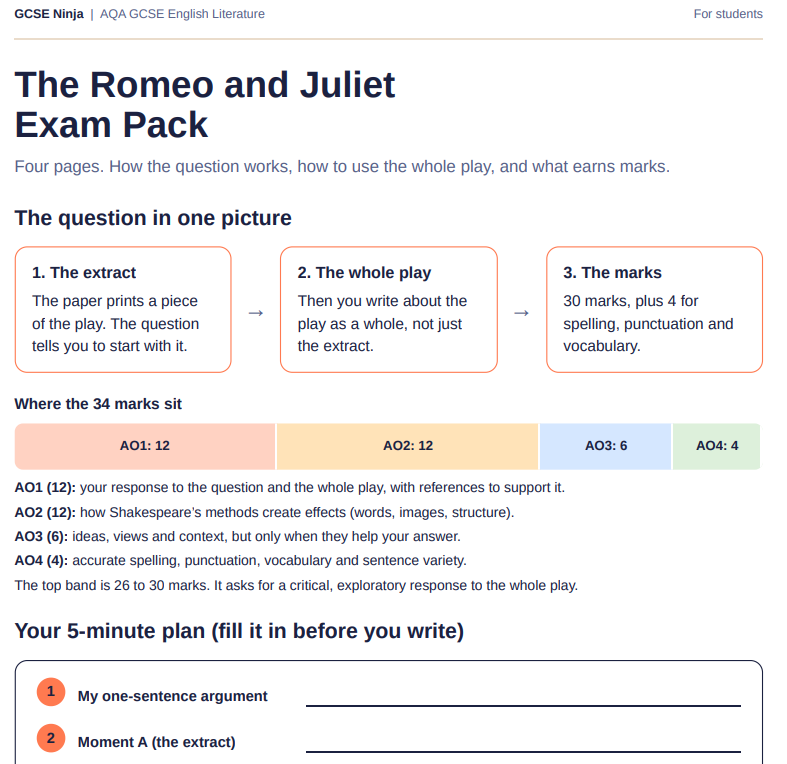
Romeo and Juliet is one choice in Section A. The question is worth 30 marks plus 4 for spelling, punctuation and vocabulary (AO4). The 30 split into 12 for your response (AO1), 12 for methods (AO2) and 6 for ideas and contexts (AO3). Top band: 26 to 30 marks.
Won marks
- An opening argument that answers the question
- A balanced view (good intentions, bad results)
- Moving between the extract and the rest of the play
- Context only when it helps the answer
Lost marks
- Learned structures and stock openings
- Calling him simply “kind” or “stupid”
- Retelling the story instead of arguing
- Talk about films, costumes or directors
Sources: AQA mark scheme 8702/1, June 2023 and June 2024; AQA Report on the Examination, June 2022 (Shakespeare section). In the four Romeo and Juliet papers we checked (November 2021, June 2022, June 2023, June 2024), three asked about Juliet and one about Romeo; none named Friar Lawrence. AQA does not publish future questions, so do not rely on a pattern.
Test yourself
Cover the answer. Say it out loud. Then open it.
1. Why does the Friar agree to marry the lovers?
He hopes it will turn the families’ hatred “to pure love”.
2. What does the word “may” show in “may so happy prove”?
It is a hope, not a certainty.
3. What image does the Friar use for fast passion in Act 2 Scene 6?
“Fire and powder”: fire and gunpowder.
4. What does he say in Act 3 Scene 3 to stop Romeo?
“Hold thy desperate hand!”
5. Who or what does he blame in Act 5 Scene 3?
“A greater power than we can contradict”.
Free revision pack and weekly tips
Enter your email for our free Romeo and Juliet exam pack (four pages: the question in one picture with a blank 5-minute plan, five themes, what earns marks, and a page for parents). You also get our weekly AQA revision tips.
Nearly there. Check your inbox now.
Tap the button in the email from GCSE Ninja to confirm, and your Romeo and Juliet pack arrives straight after.
Not there in 2 minutes? Check Promotions or Junk.
Free. Unsubscribe in one click. Privacy Policy.
Quick FAQ
Why is Friar Lawrence important in Romeo and Juliet?
He marries the lovers, gives advice, and makes the plans that go wrong. He links the play’s ideas of religion, fate and haste.
Is it Friar Lawrence or Friar Laurence?
Both spellings appear. We use the Folger spelling, Lawrence. Use the spelling in your own copy in the exam.
Will the Friar come up in the exam?
We cannot know. AQA questions start from an extract and change each year. Learn him as evidence for fate, haste and responsibility.
Where next
Read the Nurse page, the other adult Juliet trusts:
Read the Romeo page, to see the haste the Friar warns about:
See every Romeo and Juliet character in one place:
More characters:
Practise the method on real papers:
Sources checked. Quotes: Folger Shakespeare Library text. Exam facts: AQA 8702/1 mark schemes for June 2023 and June 2024, and AQA Report on the Examination, June 2022.
How this page was made: written by Julie at GCSE Ninja with AI assistance. Quotations were checked against the Folger Shakespeare Library text on 2 November 2026. Please check them against your own copy.
GCSE Ninja is written by parents, not teachers or examiners, and is not affiliated with or endorsed by AQA. Model answers are our own examples, written to AQA’s published mark scheme. They are not official AQA answers and we cannot guarantee any grade. Please check quotations against your own copy of the text.