Mercutio Quotes and Analysis – Romeo and Juliet (AQA GCSE)
By Julie at GCSE Ninja (a parent, not a teacher or examiner) · Updated 2 November 2026 · 5-minute read
Mercutio is Romeo’s funny, sharp-tongued friend. These Mercutio quotes show how the play turns: Tybalt stabs him in Act 3 Scene 1, and the feud stops being a threat and starts to cost lives.
The quick version
- Who he is: the joker of the play. He mocks love and dreams, then dies in the middle of the play.
- Learn three quotes: “be rough with love”, “a grave man” and “A plague o’ both your houses!” (below).
- The exam move: do not write “about Mercutio”. Use his death as proof for a bigger idea, like the feud.
Quotes · His death · Exam answer · Marks · Test yourself
3 Mercutio quotes to learn
Learn these three first. If you have time, open the box underneath for more.
“If love be rough with you, be rough with love; / Prick love for pricking, and you beat love down.”
Act 1 Scene 4
Say this: His advice is a list of orders (“be rough”, “Prick”, “beat”). To Mercutio, love is a fight, not a fairy tale. Set it against Romeo’s serious view of love.
“Ask for / me tomorrow, and you shall find me a grave man.”
Act 3 Scene 1
Say this: A pun. “Grave” means serious, and it also means where he is going. He is still joking when he is badly hurt, which makes the moment darker.
Yes, really: he makes a pun while dying. A comment on what that does to the tone is worth making.
“A plague o’ both your houses!”
Act 3 Scene 1
Say this: He curses both families, not just one. Neither side is excused, so the blame falls on the feud itself.
More Mercutio quotes (open if you have time)
“O, then I see Queen Mab hath been with you.” (Act 1 Scene 4) He turns Romeo’s dream into a story. Use it for his imagination.
“She is the fairies’ midwife, and she comes / In shape no bigger than an agate stone / On the forefinger of an alderman,” (Act 1 Scene 4) A fairy smaller than a stone on a town official’s finger. Tiny detail, funny image.
“True, I talk of dreams, / Which are the children of an idle brain, / Begot of nothing but vain fantasy,” (Act 1 Scene 4) He agrees with Romeo that he is talking of nothing, and calls dreams empty.
“Ay, ay, a scratch, a scratch. Marry, ’tis enough.” (Act 3 Scene 1) Romeo has just said “Courage, man, the hurt cannot be much.” Mercutio does not argue. He jokes.
“A plague o’ both houses! I am sped.” (Act 3 Scene 1) The first time he curses the families. He says it more than once.
Checked against the Folger Shakespeare Library text. Editions differ slightly, so check your own copy. “/” marks a line break.
One death changes the play
Here is the chain, using the Folger stage directions and lines:
Mercutio’s death sets off the rest of Act 3.
To see the fight on the page, read Act 3 Scene 1 in the free Folger Shakespeare Library text.
Romeo also calls him “the Prince’s near ally”, so the city suffers too, not only the two families. Use that only if your answer is about all of Verona.
Queen Mab in 30 seconds
In Act 1 Scene 4 Romeo talks of a dream. Mercutio answers with a speech about Queen Mab, a tiny fairy who visits sleepers. Romeo cuts in: “Peace, peace, Mercutio, peace. / Thou talk’st of nothing.” Soon after, Romeo says “I fear too early, for my mind misgives”. The joker dismisses dreams, and Romeo sounds worried straight after. That is useful for an answer about fate.
How to use Mercutio in the exam
AQA gives you an extract, then asks you to write about it and the whole play. Mercutio is one moment you can use as evidence. Here is our own practice question in that style (not an AQA question). When you have tried it, test yourself on real AQA English Literature past papers:
Your 5-minute plan
- Write one sentence that answers the question.
- Pick three moments: the curse, Romeo’s banishment, one from the ending.
- For each, choose one quote and one method.
- Find one idea that links all three.
- Write your opening sentence before you start.
A model paragraph (our own example)
Shakespeare uses Mercutio’s death to show that the feud harms people who were never part of it. When Mercutio cries “A plague o’ both your houses!”, the curse is aimed at Montagues and Capulets alike, and the exclamation mark turns a private complaint into a public verdict. The same man who jokes “you shall find me a grave man” now uses his wit to expose the cost of the quarrel: “grave” means serious, and also where he is going. The pun keeps his voice alive just when an audience expects only suffering, so the tone sours as the consequences become real. Soon afterwards Romeo kills Tybalt and is exiled, so the play shows the curse beginning to work. This presents the feud, not any one person, as the cause of the tragedy.
This is our own example, not an official AQA answer.
Where marks are won and lost
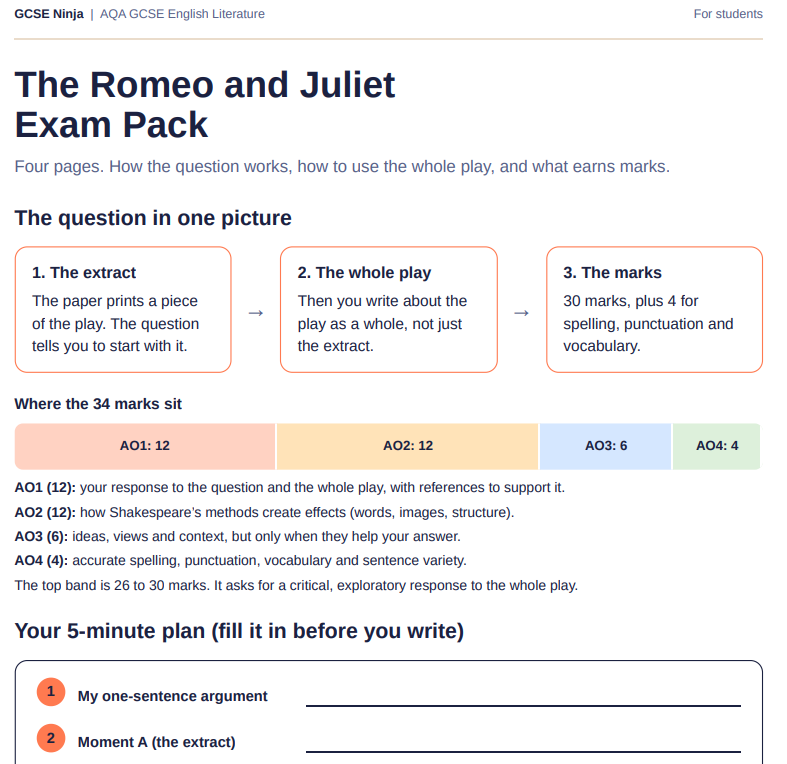
Romeo and Juliet is one choice in Section A. The question is worth 30 marks plus 4 for spelling, punctuation and vocabulary (AO4). The 30 split into 12 for your response (AO1), 12 for methods (AO2) and 6 for ideas and contexts (AO3). Top band: 26 to 30 marks.
Won marks
- An opening argument that answers the question
- Moving between the extract and the rest of the play
- Context only when it helps the answer
- A “reference” does not have to be a quote
Lost marks
- Learned structures and stock openings
- Naming a technique but not saying what it does
- Facts about Shakespeare’s England stuck on from memory
- Talk about films, costumes or directors
Sources: AQA mark scheme 8702/1, June 2023; AQA Report on the Examination, June 2022 (Shakespeare section). In the four Romeo and Juliet papers we checked (November 2021, June 2022, June 2023, June 2024), none asked about Mercutio: three were about Juliet and one about Romeo. AQA does not publish future questions, so learn him as evidence for the feud, love and fate.
Test yourself
Cover the answer. Say it out loud. Then open it.
1. Who stabs Mercutio?
Tybalt.
2. What are the two meanings of “a grave man”?
Serious, and in a grave.
3. What does Romeo say about the wound, and why does it matter?
“Courage, man, the hurt cannot be much.” Romeo underestimates it, and Mercutio jokes instead of arguing.
4. Whom does “A plague o’ both your houses” blame?
Both families. So the feud, not one person, is to blame.
5. What happens to Romeo after Tybalt falls?
The Prince says “Immediately we do exile him hence.”
Free revision pack and weekly tips
Enter your email for our free Romeo and Juliet exam pack (four pages: the question in one picture with a blank 5-minute plan, five themes, what earns marks, and a page for parents). You also get our weekly AQA revision tips.
Nearly there. Check your inbox now.
Tap the button in the email from GCSE Ninja to confirm, and your Romeo and Juliet pack arrives straight after.
Not there in 2 minutes? Check Promotions or Junk.
Free. Unsubscribe in one click. Privacy Policy.
Quick FAQ
Why is Mercutio important in Romeo and Juliet?
He contrasts with Romeo, he brings wit to the early scenes, and his death leads to Romeo killing Tybalt and being exiled.
What does “a plague o’ both your houses” mean?
It is his curse on the Montagues and Capulets. It links his death to the feud.
Will Mercutio come up in the exam?
We cannot know. AQA questions start from an extract and change each year. Learn him as evidence for the feud, love and fate.
Where next
Read the Tybalt page, the man who stabs Mercutio:
Read the Romeo page, to see how he answers the death:
See every Romeo and Juliet character in one place:
More characters:
Practise the method on real papers:
Sources checked. Quotes and stage directions: Folger Shakespeare Library text. Order of events: the Folger text and a second summary source. Exam facts: AQA 8702/1 June 2023 mark scheme and AQA Report on the Examination, June 2022.
How this page was made: written by Julie at GCSE Ninja with AI assistance. Quotations were checked against the Folger Shakespeare Library text on 2 November 2026. Please check them against your own copy.
GCSE Ninja is written by parents, not teachers or examiners, and is not affiliated with or endorsed by AQA. Model answers are our own examples, written to AQA’s published mark scheme. They are not official AQA answers and we cannot guarantee any grade. Please check quotations against your own copy of the text.