Romeo Quotes and Analysis – Romeo and Juliet (AQA GCSE)
By Julie at GCSE Ninja (a parent, not a teacher or examiner) · Updated 2 November 2026 · 6-minute read
Romeo is a romantic, impulsive Montague whose feelings move faster than his judgement. These Romeo quotes show how his love and his sense of fate lead to the ending.
The quick version
- Who he is: the Montague son who falls for Juliet, kills Tybalt and is banished.
- Learn three quotes: “Juliet is the sun”, “hanging in the stars” and “Fortune’s fool” (below).
- The exam move: show how his feelings run ahead of his judgement, early, middle and late.
Quotes · His journey · Exam answer · Marks · Test yourself
3 Romeo quotes to learn
Learn these three first. If you have time, open the box underneath for more.
“But soft, what light through yonder window breaks? / It is the East, and Juliet is the sun.”
Act 2 Scene 2
Say this: A metaphor: Juliet is not like the sun, she is the sun. The East is where the sun rises, so she is the start of a new day in his life. Set it against his earlier gloom.
“I fear too early, for my mind misgives / Some consequence yet hanging in the stars”
Act 1 Scene 4
Say this: Romeo says this to Benvolio on the way to the Capulets’ feast. “Hanging” makes the danger sound like something about to fall. It is an early hint of fate.
“O, I am Fortune’s fool!”
Act 3 Scene 1
Say this: He says it right after the stage direction “They fight. Tybalt falls.” He blames Fortune, as if he were a puppet. That is worth questioning, because he chose to fight.
Good move: ask whether he is really Fortune’s fool, or whether his own temper is to blame. Examiners reward a thoughtful argument.
More Romeo quotes (open if you have time)
“Here’s much to do with hate, but more with love.” (Act 1 Scene 1) He sees the feud around him and puts love above it.
“Why then, O brawling love, O loving hate,” (Act 1 Scene 1) Oxymorons: opposite words side by side. They show a feeling he cannot make sense of yet.
“O, she doth teach the torches to burn bright!” (Act 1 Scene 5) His first sight of Juliet. Light imagery again, and the exclamation shows the shock of it.
“Call me but love, and I’ll be new baptized. / Henceforth I never will be Romeo.” (Act 2 Scene 2) He is ready to give up his name, and so his family, for her.
“’Tis torture and not mercy. Heaven is here / Where Juliet lives” (Act 3 Scene 3) Banishment feels like punishment because it takes him away from her.
“Then I deny you, stars!” (Act 5 Scene 1) Folger prints “deny”; many books print “defy”. Either way he is turning on fate. Use the word in your own copy.
“Thus with a kiss I die.” (Act 5 Scene 3) The stage direction right after is “He dies.” His love and his death arrive in the same moment.
Checked against the Folger Shakespeare Library text. Editions differ slightly, so check your own copy. “/” marks a line break.
Romeo’s journey
A strong answer shows change. Do not list quotes. Follow the path:
Four moments that show Romeo’s path.
To read these scenes, use the free Folger Shakespeare Library text: Act 2 Scene 2 and Act 3 Scene 1.
How to use Romeo in the exam
AQA gives you an extract, then asks you to write about it and the whole play. Romeo was the focus of one of the four papers we checked (June 2022, with an Act 2 Scene 2 extract). Here is our own practice question in that style (not an AQA question). When you have tried it, test yourself on real AQA English Literature past papers:
Your 5-minute plan
- Write one sentence that answers the question.
- Pick three moments: early, middle, late.
- For each, choose one quote and one method.
- Find the idea that links them (emotion, fate, haste).
- Write your opening sentence before you start.
A model paragraph (our own example)
Shakespeare presents Romeo as a character whose emotions move faster than his judgement. In Act 1 Scene 1 he describes love through opposites, “O brawling love, O loving hate”, and the oxymorons suggest a feeling he cannot yet make sense of. Once he meets Juliet his language becomes confident and visual: “It is the East, and Juliet is the sun” is a metaphor that makes her the source of light in his world. Yet the same speed troubles him. On the way to the Capulets’ feast he fears “Some consequence yet hanging in the stars”, where the verb “hanging” makes the danger sound as if it is about to fall. After Tybalt falls, his cry “O, I am Fortune’s fool!” blames fate, which suggests he sees himself as a victim even though he chose to fight. This presents Romeo’s passion as the source of both the play’s love and its tragedy.
This is our own example, not an official AQA answer.
Where marks are won and lost
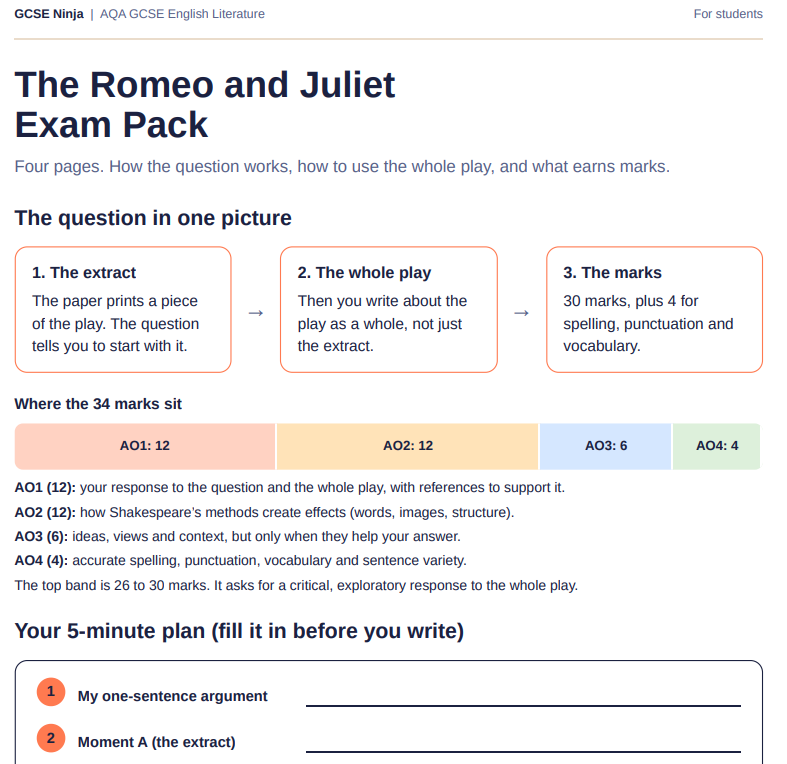
Romeo and Juliet is one choice in Section A. The question is worth 30 marks plus 4 for spelling, punctuation and vocabulary (AO4). The 30 split into 12 for your response (AO1), 12 for methods (AO2) and 6 for ideas and contexts (AO3). Top band: 26 to 30 marks.
Won marks
- An opening argument that answers the question
- Moving between the extract and the rest of the play
- Questioning an idea (is he really Fortune’s fool?)
- Context only when it helps the answer
Lost marks
- Learned structures and stock openings
- Naming a technique but not saying what it does
- Retelling the story instead of arguing
- Talk about films, costumes or directors
Sources: AQA mark scheme 8702/1, June 2023 and June 2024; AQA Report on the Examination, June 2022 (Shakespeare section). In the four Romeo and Juliet papers we checked (November 2021, June 2022, June 2023, June 2024), one asked about Romeo and three about Juliet. AQA does not publish future questions, so do not rely on a pattern.
Test yourself
Cover the answer. Say it out loud. Then open it.
1. What is “brawling love, O loving hate” an example of?
Oxymorons: opposite words together, showing mixed feelings.
2. What does the metaphor “Juliet is the sun” suggest?
She is the light and centre of his world, and a new start.
3. What does “hanging in the stars” suggest?
A fate or danger that has not fallen yet.
4. Who does Romeo blame in “O, I am Fortune’s fool!”?
Fortune, or fate. You can question whether he is right.
5. What is the stage direction right after “Thus with a kiss I die”?
“He dies.”
Free revision pack and weekly tips
Enter your email for our free Romeo and Juliet exam pack (four pages: the question in one picture with a blank 5-minute plan, five themes, what earns marks, and a page for parents). You also get our weekly AQA revision tips.
Nearly there. Check your inbox now.
Tap the button in the email from GCSE Ninja to confirm, and your Romeo and Juliet pack arrives straight after.
Not there in 2 minutes? Check Promotions or Junk.
Free. Unsubscribe in one click. Privacy Policy.
Quick FAQ
Why is Romeo important in Romeo and Juliet?
His feelings drive the plot: he falls for Juliet, kills Tybalt, is banished, and ends the play by taking his own life.
Is Romeo to blame for the tragedy?
Both views are available. Fate (“Fortune’s fool”) and the feud play a part, but Romeo also chooses to fight and to act in haste. A balanced argument scores well.
Will Romeo come up in the exam?
We cannot know. One of the four papers we checked focused on him. Learn him as evidence for love, fate and haste.
Where next
Read the Juliet page, to see the other side of the love story:
Read the Tybalt page, the cousin whose death Romeo causes:
See every Romeo and Juliet character in one place:
More characters:
Practise the method on real papers:
Sources checked. Quotes: Folger Shakespeare Library text. Exam facts: AQA 8702/1 mark schemes for June 2023 and June 2024, and AQA Report on the Examination, June 2022.
How this page was made: written by Julie at GCSE Ninja with AI assistance. Quotations were checked against the Folger Shakespeare Library text on 2 November 2026. Please check them against your own copy.
GCSE Ninja is written by parents, not teachers or examiners, and is not affiliated with or endorsed by AQA. Model answers are our own examples, written to AQA’s published mark scheme. They are not official AQA answers and we cannot guarantee any grade. Please check quotations against your own copy of the text.