Juliet Quotes and Analysis – Romeo and Juliet (AQA GCSE)
By Julie at GCSE Ninja (a parent, not a teacher or examiner) · Updated 2 November 2026 · 6-minute read
Juliet was the focus of three of the four Romeo and Juliet papers we checked. These Juliet quotes show how she changes from a girl caught between two families into someone who makes her own choices, and what she pays for them.
The quick version
- Who she is: Capulet’s daughter, who falls for a Montague and takes more and more control of her own life.
- Learn three quotes: “My only love sprung from my only hate!”, “wherefore art thou Romeo?” and “Gallop apace, you fiery-footed steeds” (below).
- The exam move: show how she changes. One quote from early, one from the middle, one from late.
Quotes · Her change · Exam answer · Marks · Test yourself
3 Juliet quotes to learn
Learn these three first. If you have time, open the box underneath for more.
“My only love sprung from my only hate!”
Act 1 Scene 5
Say this: She has just learned Romeo is a Montague. The repeated “only” and the opposite words “love” and “hate” show how one person is both her greatest feeling and her family’s enemy.
“O Romeo, Romeo, wherefore art thou Romeo?”
Act 2 Scene 2
Say this: “Wherefore” means why, not where. She is asking why he has to be a Montague. The repeated name shows she cannot stop thinking about it, and the question points at the feud.
Common slip: writing that she is looking for him. She is not. A one-line correction like this shows you understand the language.
“Gallop apace, you fiery-footed steeds”
Act 3 Scene 2
Say this: It is an order (an imperative). She tells the sun’s horses to hurry so night, and Romeo, can arrive. Her impatience is joyful here, and the scene soon turns when she hears the news about Tybalt.
More Juliet quotes (open if you have time)
“What’s in a name? That which we call a rose” (Act 2 Scene 2) She argues a name is only a label. Use it for her view of the feud.
“My bounty is as boundless as the sea,” (Act 2 Scene 2) The sound repeats (“bounty”, “boundless”) and the sea image suggests a love with no limit.
“It is too rash, too unadvised, too sudden, / Too like the lightning, which doth cease to be / Ere one can say ‘It lightens.’” (Act 2 Scene 2) She worries about the speed of it herself. Useful for haste and fate.
“Good night, good night. Parting is such sweet / sorrow” (Act 2 Scene 2) A contradiction (oxymoron): the pain and pleasure of leaving are one feeling.
“Give me my Romeo … Take him and cut him out in little stars,” (Act 3 Scene 2) She wants him to live on after death. The lines between are left out here.
“He shall not make me there a joyful bride!” (Act 3 Scene 5) She refuses the marriage arranged for her. The firm “shall not” is the opposite of obedience.
“I’ll to the Friar to know his remedy. / If all else fail, myself have power to die.” (Act 3 Scene 5) She makes a plan. Death is the one choice she feels is still hers.
Checked against the Folger Shakespeare Library text. Editions differ slightly, so check your own copy. “/” marks a line break.
How Juliet changes
This is the idea that lifts an answer. Do not list quotes. Show a journey:
Four moments that show Juliet taking control.
To read these scenes, use the free Folger Shakespeare Library text: Act 3 Scene 2 and Act 3 Scene 5.
How to use Juliet in the exam
AQA gives you an extract, then asks you to write about it and the whole play. In the Romeo and Juliet papers we checked, Juliet was the focus more than any other character. Here is our own practice question in that style (not an AQA question). When you have tried it, test yourself on real AQA English Literature past papers:
Your 5-minute plan
- Write one sentence that answers the question.
- Pick three moments: early, middle, late.
- For each, choose one quote and one method.
- Find the idea that links them (control, family, love).
- Write your opening sentence before you start.
A model paragraph (our own example)
Shakespeare presents Juliet as someone who moves from reacting to events to taking charge of them. On discovering that Romeo is a Montague she says “My only love sprung from my only hate!”, where the repeated “only” and the opposition of “love” and “hate” show her trapped between two forces she did not choose. By Act 3 Scene 2 her voice has changed: the imperative “Gallop apace, you fiery-footed steeds” orders the sun’s horses to hurry, suggesting she now expects the world to move for her love. In Act 3 Scene 5 she refuses the marriage her father has arranged, “He shall not make me there a joyful bride!”, and the firm “shall not” is the opposite of obedience. Her final plan, “myself have power to die”, shows control, but it is control gained only because every other choice has been taken from her. This presents her independence as admirable, and also as a measure of how far the feud and her family’s demands have limited her.
This is our own example, not an official AQA answer.
Where marks are won and lost
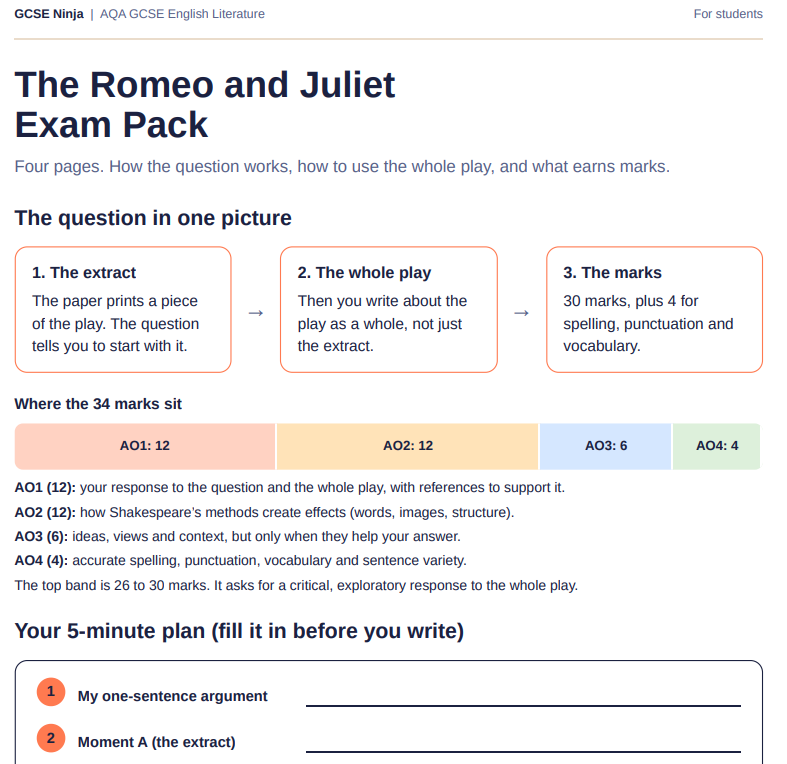
Romeo and Juliet is one choice in Section A. The question is worth 30 marks plus 4 for spelling, punctuation and vocabulary (AO4). The 30 split into 12 for your response (AO1), 12 for methods (AO2) and 6 for ideas and contexts (AO3). Top band: 26 to 30 marks.
Won marks
- An opening argument that answers the question
- Moving between the extract and the rest of the play
- Context only when it helps the answer
- Showing change over time, not a list of quotes
Lost marks
- Learned structures and stock openings
- Naming a technique but not saying what it does
- Retelling the story instead of arguing
- Facts about Shakespeare’s England stuck on from memory
Sources: AQA mark scheme 8702/1, June 2023 and June 2024; AQA Report on the Examination, June 2022 (Shakespeare section). In the four Romeo and Juliet papers we checked (November 2021, June 2022, June 2023, June 2024), three asked about Juliet (extracts from Act 3 Scene 2 in 2021 and 2023, Act 2 Scene 5 in 2024) and one about Romeo. AQA does not publish future questions, so do not rely on a pattern.
Test yourself
Cover the answer. Say it out loud. Then open it.
1. What does “wherefore” mean in “wherefore art thou Romeo”?
Why, not where. She is asking why he has to be a Montague.
2. Which word does Juliet repeat in “My only love sprung from my only hate”?
“Only”. Together with “love” and “hate” it shows one person who is both.
3. What does the imperative “Gallop apace” show?
She is giving orders and cannot wait. Her impatience is joyful.
4. How does Juliet refuse the marriage in Act 3 Scene 5?
“He shall not make me there a joyful bride!”
5. What does “myself have power to die” suggest?
She sees death as the last choice she controls.
Free revision pack and weekly tips
Enter your email for our free Romeo and Juliet exam pack (four pages: the question in one picture with a blank 5-minute plan, five themes, what earns marks, and a page for parents). You also get our weekly AQA revision tips.
Nearly there. Check your inbox now.
Tap the button in the email from GCSE Ninja to confirm, and your Romeo and Juliet pack arrives straight after.
Not there in 2 minutes? Check Promotions or Junk.
Free. Unsubscribe in one click. Privacy Policy.
Quick FAQ
Why is Juliet important in Romeo and Juliet?
She changes more than anyone else in the play, and her choices drive the plot after the fight in Act 3.
What does “wherefore art thou Romeo” mean?
“Wherefore” means “why”. She is asking why he must be a Montague, not where he is.
Will Juliet come up in the exam?
We cannot know. She has been the focus often, but AQA does not publish future questions. AQA questions start from an extract and change each year. Learn her as evidence for love, family and control.
Where next
Read the Nurse page, the person closest to Juliet:
Read the Friar Lawrence page, the adult who plans her escape:
See every Romeo and Juliet character in one place:
More characters:
Practise the method on real papers:
Sources checked. Quotes: Folger Shakespeare Library text. Exam facts: AQA 8702/1 mark schemes for June 2023 and June 2024, and AQA Report on the Examination, June 2022.
How this page was made: written by Julie at GCSE Ninja with AI assistance. Quotations were checked against the Folger Shakespeare Library text on 2 November 2026. Please check them against your own copy.
GCSE Ninja is written by parents, not teachers or examiners, and is not affiliated with or endorsed by AQA. Model answers are our own examples, written to AQA’s published mark scheme. They are not official AQA answers and we cannot guarantee any grade. Please check quotations against your own copy of the text.