Shall earth no more inspire thee by Emily Brontë: Analysis, Quotes and Exam Use (AQA Worlds and Lives)
By Julie at GCSE Ninja (a parent, not a teacher or examiner) · Updated 5 November 2026 · 5-minute read
Nature speaks to a lonely dreamer and offers friendship and a home. The full poem is out of copyright. This page covers what the poem is about, the quotes worth learning, how to use it in the AQA Worlds and Lives comparison question, and which poem to pair it with.
Get the free 15-sheet poetry packThe quick version
- Big idea: Nature itself speaks to a “lonely dreamer” who has lost inspiration. The poem offers the natural world as a loving companion and a place where the lonely can belong.
- Learn these quotes: “lonely dreamer”, “Then let my winds caress thee”, “Thy comrade let me be”.
- Pair it with: Lines Written in Early Spring, With Birds You’re Never Lonely, Homing.
Quotes · Themes · Pairings · Exam answer · Marks · Free pack
What the poem is about
Nature itself speaks to a “lonely dreamer” who has lost inspiration. The poem offers the natural world as a loving companion and a place where the lonely can belong.
Context that helps (AO3)
- Victorian poet: Brontë is closely linked with the Yorkshire moors; wild landscape runs through her writing (AO3).
- Voice: The voice in the later stanzas is nature speaking to the person (see “let my winds”), so the addressee is the “dreamer”.
Context is only worth including if it explains a choice the poet made. A fact stuck on from memory loses focus (AQA Report on the Examination, Paper 1, June 2024).
Key quotes and what to say about them
Short extracts only. Check each one against your own copy before you use it.
“lonely dreamer”
Say this: Isolation combined with imagination; the person is cut off but also creative.
Another way to read it: the “dreamer” could be the poet’s own imagination, so she may be addressing herself.
“Then let my winds caress thee”
Say this: Nature is personified as tender; “caress” makes the wind affectionate and physical.
Another way to read it: “let” asks permission, so nature waits to be invited instead of forcing itself on the listener.
“Thy comrade let me be”
Say this: Archaic “thee/thy” gives a prayer-like, intimate tone; nature asks for friendship.
Another way to read it: it is a request, not an order, so nature humbles itself.
“Return—and dwell with me”
Say this: A final imperative invitation: a call to come home to nature.
Another way to read it: “dwell” means live somewhere, so the offer is of a home, not a visit.
Both readings are our own interpretations, not AQA’s. Quotes checked against several online texts.
Themes and form
Themes: Nature as comfort and companion, loneliness and isolation, imagination and inspiration, belonging.
Form and structure (AO2)
The poem is 28 lines in seven four-line stanzas, with a regular rhythm that feels like a song or chant. Notice the questions at the start and the offer at the end: how does the poem move from doubt to invitation?
Free: all 15 Worlds and Lives revision sheets

One page per poem: the big idea, context, language, form and which poem to compare it with. Free, sent straight to your inbox.
Free. Unsubscribe in one click. Privacy Policy.
Which poem to compare it with
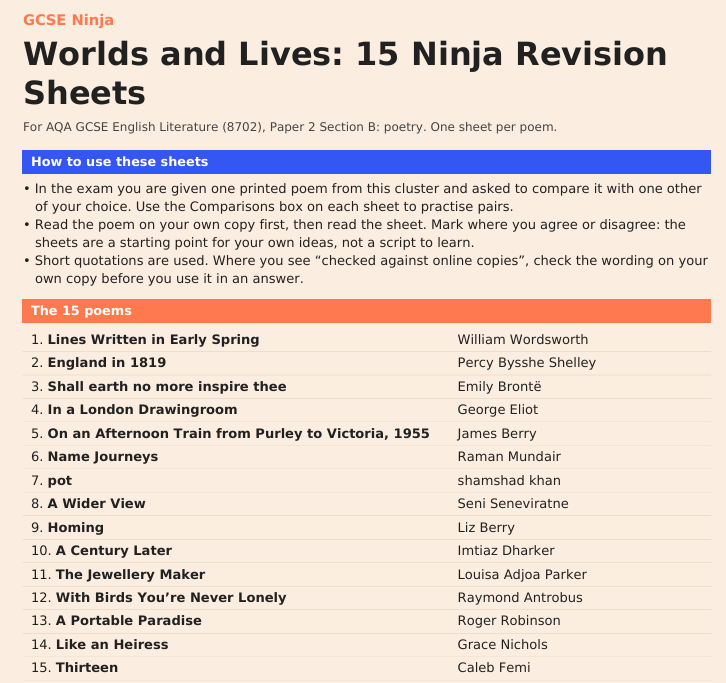
In the exam you are given one printed poem and compare it with one other from the cluster. These pairings are our suggestions, not AQA’s.
- Lines Written in Early Spring: both place the human heart in conversation with nature.
- With Birds You’re Never Lonely: both link nature and loneliness.
- Homing: both are about where a person belongs, one in nature and one in speech.
See all 15 poems and pairings.
How to use it in the exam
Here is our own practice question in the AQA style (not an AQA question):
Your 5-minute plan
- Underline the focus words: how, and loneliness and nature.
- Choose your second poem. Try With Birds You’re Never Lonely.
- Pick one short quote from each poem.
- For each quote, name one method and say what it does.
- Write one sentence that answers the question and links both poems.
A model paragraph (our own example)
Brontë reverses the expected direction: instead of a person reaching for nature, nature reaches for a “lonely dreamer”. The personified wind promises to “caress” the listener, a tender, physical verb, and asks “Thy comrade let me be”, where the old-fashioned “thy” gives the request a prayer-like intimacy. The poem ends with an invitation, “Return—and dwell with me”, so loneliness is answered by belonging in the natural world. Set against Antrobus’s “silence that was not an absence”, both poets present nature as company rather than threat, though Brontë gives nature a voice and Antrobus gives the speaker the listening.
AO4 (spelling, punctuation, vocabulary) is not assessed in Section B for this question type in the June 2024 paper we checked. This is our own example, not an official AQA answer. AQA’s June 2024 report praised answers that opened with a clear argument and said that pre-learned structures held some students back, so use this as a model of thinking, not a template.
Where marks are won and lost
Section B (poetry) is worth 30 marks: 12 for your response (AO1), 12 for methods (AO2) and 6 for ideas and contexts (AO3) (AQA mark scheme 8702/2, June 2024). The Worlds and Lives format, one printed poem plus one other, comes from the Collins teacher guide hosted on AQA’s site and revision sites; we have not checked it against AQA’s specification.
Won marks
- An opening argument that answers the question
- Moving between the two poems in every paragraph
- Naming a method and saying what it does
Lost marks
- Writing about one poem only
- Learned structures and stock openings
- Context that does not explain a choice
Sources: AQA mark scheme 8702/2 and Report on the Examination, June 2024 (Paper 2).
Quick FAQ
What is Shall earth no more inspire thee about?
Nature speaks to a lonely dreamer and offers friendship and a home.
Which poem should I compare Shall earth no more inspire thee with?
Lines Written in Early Spring (both place the human heart in conversation with nature.) See the other pairings above. Any poem from the cluster can be used, so choose the one you can write about best.
Can I quote this poem in full?
Yes. It is out of copyright. Read it in full in your anthology and learn short quotes you can use.
Where next
All 15 poems in one place:
Practise the method on real papers:
Previous and next poems in the cluster:
England in 1819 In a London Drawingroom
Find every text we cover:
Sources checked. Quotes: several online copies (see page notes), not the printed book. Exam facts: AQA 8702/2 mark scheme and Report on the Examination, June 2024; Worlds and Lives format from the Collins teacher guide hosted on filestore.aqa.org.uk. Context: standard sources.
GCSE Ninja is written by parents, not teachers or examiners, and is not affiliated with or endorsed by AQA. Model answers are our own examples, written to AQA’s published mark scheme. They are not official AQA answers and we cannot guarantee any grade. Please check quotations against your own copy of the text.