England in 1819 by Percy Bysshe Shelley: Analysis, Quotes and Exam Use (AQA Worlds and Lives)
By Julie at GCSE Ninja (a parent, not a teacher or examiner) · Updated 5 November 2026 · 5-minute read
Shelley condemns king, army, laws and Parliament, and ends on a ghostly hope. The full poem is out of copyright. This page covers what the poem is about, the quotes worth learning, how to use it in the AQA Worlds and Lives comparison question, and which poem to pair it with.
Get the free 15-sheet poetry packThe quick version
- Big idea: Shelley condemns every pillar of the English establishment: king, princes, army, law and Parliament. He ends with a fragile, ghostly hope that something better might rise from the ruins.
- Learn these quotes: “A people starved and stabbed”, “Golden and sanguine laws”, “Time’s worst statute, unrepealed”.
- Pair it with: Lines Written in Early Spring, A Century Later, In a London Drawingroom.
Quotes · Themes · Pairings · Exam answer · Marks · Free pack
What the poem is about
Shelley condemns every pillar of the English establishment: king, princes, army, law and Parliament. He ends with a fragile, ghostly hope that something better might rise from the ruins.
Context that helps (AO3)
- Radical politics: Shelley was a political radical who wanted reform and opposed monarchy (AO3).
- 1819: The year of the Peterloo massacre in Manchester, a time of unrest and hardship (AO3).
Context is only worth including if it explains a choice the poet made. A fact stuck on from memory loses focus (AQA Report on the Examination, Paper 1, June 2024).
Key quotes and what to say about them
Short extracts only. Check each one against your own copy before you use it.
“A people starved and stabbed”
Say this: Two violent verbs in one phrase; the ordinary people are shown as victims of those in power.
Another way to read it: starved suggests slow neglect and stabbed suggests sudden violence, so two kinds of harm sit in one phrase.
“Golden and sanguine laws”
Say this: “golden” suggests wealth and “sanguine” suggests blood; the laws protect money at a bloody cost.
Another way to read it: “sanguine” can also mean hopeful, so the laws may look cheerful while being deadly.
“Time’s worst statute, unrepealed”
Say this: The law is old and still in force: oppression is built in and not being challenged.
Another way to read it: Time is personified as a lawmaker, and the worst law is simply left to run.
“glorious Phantom”
Say this: Hope arrives as something ghostly and uncertain, rising from “graves”.
Another way to read it: the poem never says what the Phantom is, so the reader decides whether it means revolution or reform.
Both readings are our own interpretations, not AQA’s. Quotes checked against several online texts.
Themes and form
Themes: Corrupt and failing power, poverty and suffering, anger at institutions, fragile hope for change.
Form and structure (AO2)
A single 14-line poem, built from a long list of what is wrong. The last two lines rhyme (“may” / “day”) like a closing couplet: ask whether that neat ending feels hopeful or only possible. Count the lines on your copy and note where the list stops and the hope begins.
Free: all 15 Worlds and Lives revision sheets

One page per poem: the big idea, context, language, form and which poem to compare it with. Free, sent straight to your inbox.
Free. Unsubscribe in one click. Privacy Policy.
Which poem to compare it with
In the exam you are given one printed poem and compare it with one other from the cluster. These pairings are our suggestions, not AQA’s.
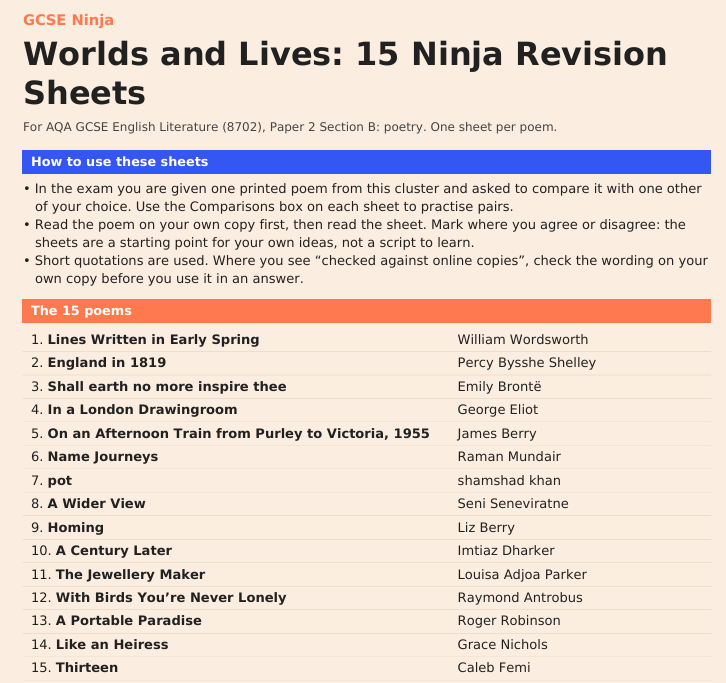
- Lines Written in Early Spring: both are Romantic poems criticising human society; very different tone.
- A Century Later: both show ordinary people harmed by power, and both end with a kind of defiance.
- In a London Drawingroom: both present a society that harms and traps people.
See all 15 poems and pairings.
How to use it in the exam
Here is our own practice question in the AQA style (not an AQA question):
Your 5-minute plan
- Underline the focus words: how, and anger at those in power.
- Choose your second poem. Try Lines Written in Early Spring.
- Pick one short quote from each poem.
- For each quote, name one method and say what it does.
- Write one sentence that answers the question and links both poems.
A model paragraph (our own example)
Shelley turns the machinery of government into a list of crimes. The “Golden and sanguine laws” fuse wealth (“golden”) with blood (“sanguine”), so one phrase suggests the laws protect money at a bloody cost. He then calls the oppression “Time’s worst statute, unrepealed”: the law is still in force because nobody has removed it. Yet the ending offers “a glorious Phantom”, hope arriving as something ghostly and uncertain, so his anger comes with only a fragile promise of change. Compared with Wordsworth’s quiet grief, Shelley writes as a radical reacting to the unrest of 1819.
AO4 (spelling, punctuation, vocabulary) is not assessed in Section B for this question type in the June 2024 paper we checked. This is our own example, not an official AQA answer. AQA’s June 2024 report praised answers that opened with a clear argument and said that pre-learned structures held some students back, so use this as a model of thinking, not a template.
Where marks are won and lost
Section B (poetry) is worth 30 marks: 12 for your response (AO1), 12 for methods (AO2) and 6 for ideas and contexts (AO3) (AQA mark scheme 8702/2, June 2024). The Worlds and Lives format, one printed poem plus one other, comes from the Collins teacher guide hosted on AQA’s site and revision sites; we have not checked it against AQA’s specification.
Won marks
- An opening argument that answers the question
- Moving between the two poems in every paragraph
- Naming a method and saying what it does
Lost marks
- Writing about one poem only
- Learned structures and stock openings
- Context that does not explain a choice
Sources: AQA mark scheme 8702/2 and Report on the Examination, June 2024 (Paper 2).
Quick FAQ
What is England in 1819 about?
Shelley condemns king, army, laws and Parliament, and ends on a ghostly hope.
Which poem should I compare England in 1819 with?
Lines Written in Early Spring (both are Romantic poems criticising human society; very different tone.) See the other pairings above. Any poem from the cluster can be used, so choose the one you can write about best.
Can I quote this poem in full?
Yes. It is out of copyright. Read it in full in your anthology and learn short quotes you can use.
Where next
All 15 poems in one place:
Practise the method on real papers:
Previous and next poems in the cluster:
Lines Written in Early Spring Shall earth no more inspire thee
Find every text we cover:
Sources checked. Quotes: several online copies (see page notes), not the printed book. Exam facts: AQA 8702/2 mark scheme and Report on the Examination, June 2024; Worlds and Lives format from the Collins teacher guide hosted on filestore.aqa.org.uk. Context: standard sources.
GCSE Ninja is written by parents, not teachers or examiners, and is not affiliated with or endorsed by AQA. Model answers are our own examples, written to AQA’s published mark scheme. They are not official AQA answers and we cannot guarantee any grade. Please check quotations against your own copy of the text.